- the weekly swarm
- Posts
- Copilot Get's GPT-5’s Real-Time Router
Copilot Get's GPT-5’s Real-Time Router
GPT-5 Chooses The Model for You. More Accurate and cost effective.

Mike West
September 15, 2025
In partnership with

The Gold standard for AI news

AI keeps coming up at work, but you still don't get it?
That's exactly why 1M+ professionals working at Google, Meta, and OpenAI read Superhuman AI daily.
Here's what you get:
Daily AI news that matters for your career - Filtered from 1000s of sources so you know what affects your industry.
Step-by-step tutorials you can use immediately - Real prompts and workflows that solve actual business problems.
New AI tools tested and reviewed - We try everything to deliver tools that drive real results.
All in just 3 minutes a day

Hello everyone and welcome to my newsletter where I discuss real-world skills needed for the top data jobs and specifically the AI Agent Role. 👏
This week we discuss GPT-5 routing capabilities.
Not a subscriber? Join the informed. Over 200K people read my content monthly.
Thank you. 🎉
Wait? What’s real-time routing?
Short version: it’s GPT-5’s built-in “traffic cop.”
In ChatGPT, a real-time router watches your prompt/context and instantly decides which internal GPT-5 path to use—fast “main” for routine turns, or the deeper GPT-5-thinking path when the task looks harder (it also considers tool needs and explicit cues like “think hard about this”). It keeps learning from real usage signals (e.g., when people switch models, preference ratings, measured correctness).
A real-time router watches your prompt/context and instantly decides which internal GPT-5 path to use.
GPT-5 isn’t one model — it’s a system of models. Here’s the lineup:
GPT-5 Main: fast, capable, optimized for most everyday queries.
GPT-5 Thinking: slower, more expensive, but designed for deeper reasoning and multi-step logic.
Mini/Nano Variants: stripped-down versions for high-volume, low-cost use cases.
Router: the decision-maker that picks which one to use.
This design reflects a simple truth: not every question deserves the same horsepower. Asking for the weather doesn’t need the same brainpower as solving a novel math proof.
How does the model decide what to use. There are many things that contribute but conversation complexity, the tools needed, explicit intent and usage constraints all play a significant role in what model is chosen.
For example, if you say… think about this harder… the router will learn toward the GPT-5 thinking model.
One unique benefit of using the GPT-5 system is that it enables the agent you build in Copilot Studio to utilize your instructions and prompts as a guide for selecting the ideal model using GPT-5’s real-time router for each task or response.
For simple or routine prompts and instructions, GPT-5’s high-throughput model for chat is used, prioritizing speed and straightforward responses.
For complex or more open-ended agent steps, GPT-5’s deeper reasoning model will be used, taking its time to craft a plan, gather and comprehend all relevant context, and check its work before providing a thorough response.
Before we discuss orchestration, let’s define what is within the confines of Copilot Studio. The Copilot orchestrator is the core, automated decision-making engine that powers Microsoft's Copilot experiences, while Copilot Studio is the low-code platform that developers and business users use to customize and build their own AI agents that the orchestrator can call upon. Think of the orchestrator as the conductor and Copilot Studio as the tool for creating the individual musicians
The Copilot orchestrator is the core, automated decision-making engine that powers Microsoft's Copilot experiences,
An agent’s orchestration model powers how it interprets instructions, generates a plan, uses tools, and responds with generative answers. Smarter orchestration means sharper agents.
With GPT-5, agents built in Copilot Studio have sharper reasoning in ambiguous situations to determine the right next step, increased coherence in multi-turn conversations, and stronger instruction following, all of which improve overall agent performance.
From today, AI Agent Engineers building agents in early release cycle environments will see a new option to pick their agent’s model in the settings page. If makers select GPT-5 Auto, then the agent will use GPT-5’s real-time router to choose the right model, either GPT-5’s high-throughput model or the deep reasoning model, allowing the agent to self-select the right balance of speed and planning. Alternatively, AI Agent Engineers can select GPT-5 Reasoning to ensure that the agent primarily uses the deep reasoning model for complex scenarios.
NOTE: The term Microsoft uses for AI Agent Engineers who use low code/no code tools only is makers. I have no idea why they did that. It’s moronic. However, when you are reading Microsoft documentations about Copilot Studio and see the word maker, just insert AI Agent Engineer.
Where do you choose your model in Copilot Studio? Once your model is built, head to Settings and choose Generative AI. Scroll down until you see the Model subheading and pick the model you want. The picture below shows that location.
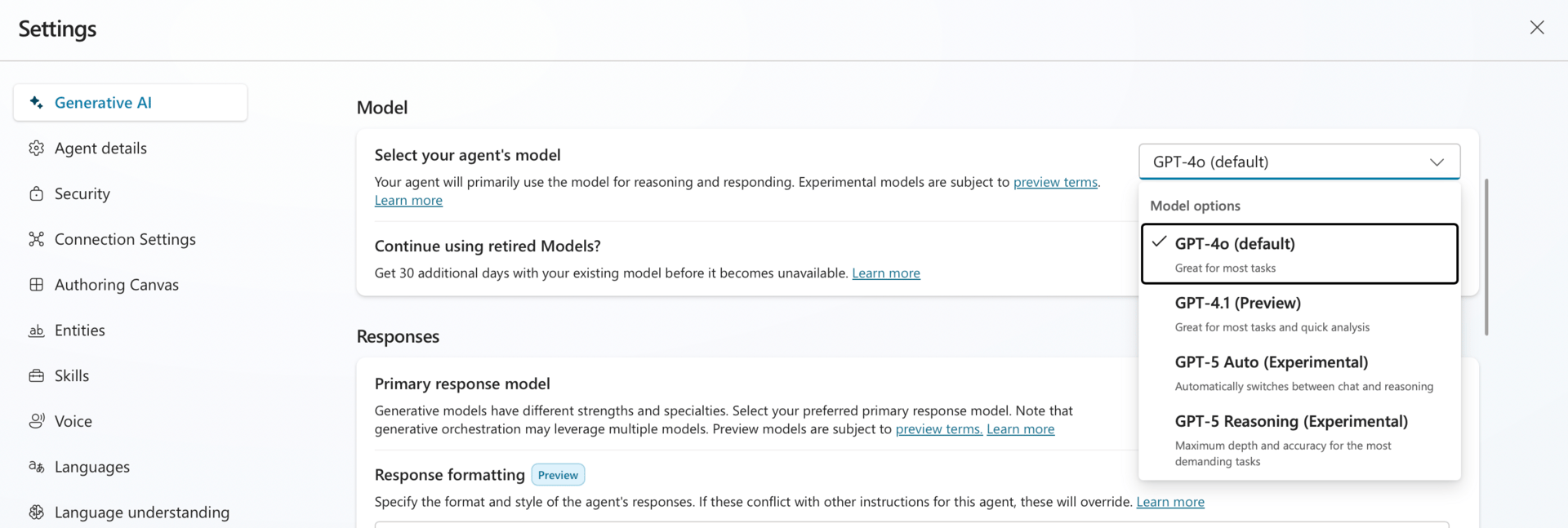
Model Selection
In conclusion, a real-time reasoning router is like traffic cop that chooses the best model based on the information it’s fed. It’s important to understand that GPT-5 isn’t a single model, it’s a group of model. Agents will have different needs and it’s up to you to understand those needs and choose the correct model.
Interested in becoming an AI Agent Engineer using Copilot Studio on the world’s top data ecosystem called Fabric? LogikBot has you covered.
Navigate to logikbot and get started today. The AI Agent Engineer will be one of the top job in the coming years. Use the coupon code YOUTUBE25 to get 20% off the subscription.
By 2040, AI will likely automate or transform 50% to 60% of jobs, with full dominance (80% and higher) possible by 2050, assuming steady innovation. Much of this will be done by AI Agents.